The Scariest Thing I Ever Saw. Ever.

•October 22, 2013 • 2 Comments
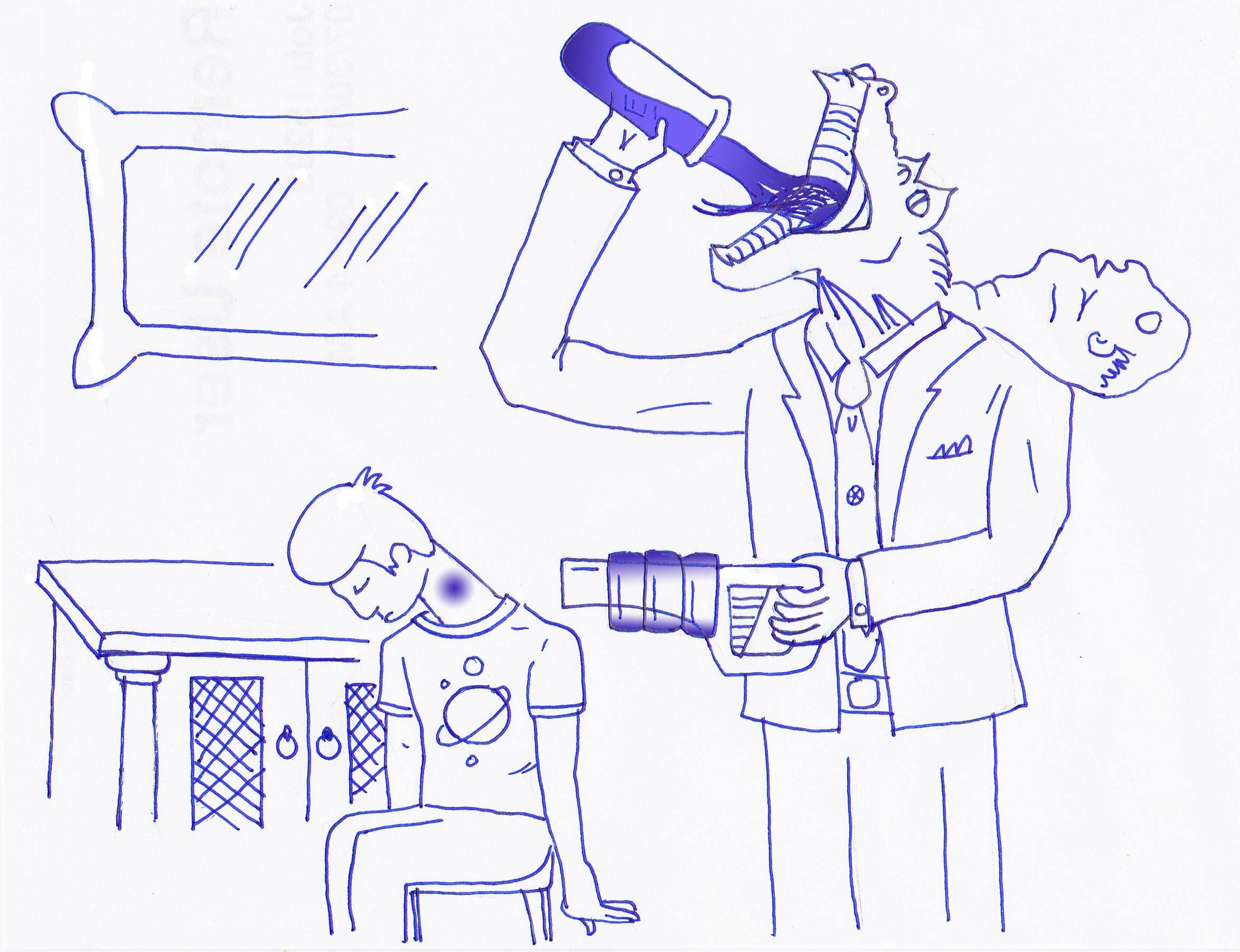
Man busted on the highway texting and driving

Scene seen all too often … if this is you, consider yourself BUSTED!

The picture says it all.

By Jeffrey Bishop.

Unfortunately, each of us sees something like this on the road every day.  Incredibly, the text-driving offenders are usually plowing down the fast lane, careening back and forth off the white lines demarcating their lanes.  I’m torn between speeding up to shake my fist at them, slowing down and changing lanes to get some distance, or laying on the horn to warn them and others of the danger.

Recently, I’ve tried a friendly “long-short short-long” horn tap — Morse code for “X” — to try to send a message.  But really:  in an era of texting, who knows Morse code?  I see the irony — and am no such out-of-time anachronism that I didn’t have to Google for a chart to figure out how to represent the 24th letter of the alphabet with horn toots.

In all seriousness:  What can be done about this deadly menace?  How do you react on the roads when you see people texting and driving?  Are you part of the problem, or part of the solution?  It’s definitely a first-world problem, and one of our own making.  What can we do to raise awareness and end this scary threat to mankind?

THE END
Copyright 2013

Map of the United States showing states with t...

Map of the United States showing states with texting while driving laws. States in red ban texting while driving for all drivers, while states in yellow do so only for new drivers. (Photo credit: Wikipedia)

Do Unto Others

•October 15, 2013 • 3 Comments
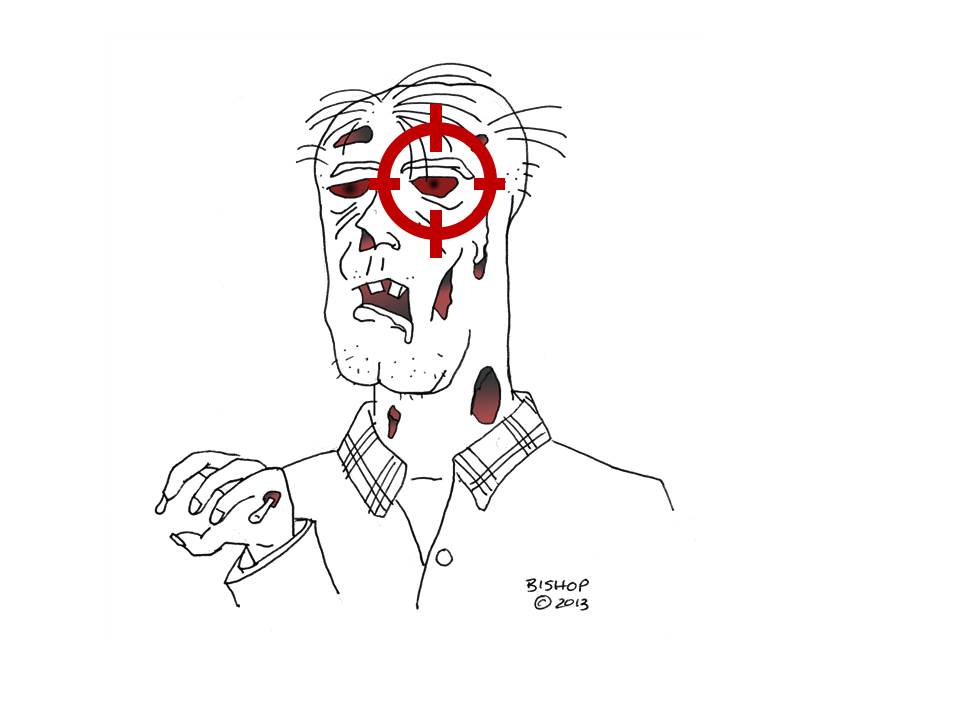
Zombie in the cross hairs

Dead eye

… Before they do unto you.

By Jeffrey Bishop

Tell Time:  4 minutes
Scare Rating:  4 of 5 Ghosts

Axom’s rooftop perch offered the perfect vantage  The setting sun warmed his back and illuminated the kill zone of the town square below.  Long after the alleys had succumbed to the darkness of the increasing twilight, he’d be able to see — and pick off — any ghouls that witlessly ventured into the cross-hairs of his sights.

“Round,” he whispered.  Bandit silently lifted a bullet from the canvas satchel on the ground at his feet and slipped it into his father’s hand.  The man gingerly placed it into the chamber of the rifle and moved the bolt home. The smooth action of the well-oiled mechanism silently placed the high-explosive shell into the starting chocks of its final path.

Bandit leaned forward and peered over the low wall of their building’s roof.  He’d learned long ago how to move stealthily, to see without being seen, and to fully assist his father without distracting him or detracting from his work.  Anything less put their livelihood — or their lives — at risk

As savvy as the 12-year-old was, he had a lot to learn from his dad.  He peered deep into the shadows surrounding the square, but didn’t find what his father was hunting.  The boy softened his gaze from a narrow aperture to a wide, relaxed view.  Instead of looking for a tell-tale shape, he waited for motion.

There it was.  In his left-side peripheral vision, he saw the familiar shuffling motion; picked out the subtlety of the green-grey flesh ambling against a blue-grey shadowy background.  The undead emerged into the square, also scanning for prey, but with a more primitive, but equally deadly weapon set.

As the zombie shuffled across the square, Dad stiffened, and his breathing became shallow and slow.  Bandit knew what happened next.  He’d seen it many times before.  He wanted to watch again, to revel in his Dad’s well-honed skill, but he had his own job to do.  The boy eased back from the brick barricade and silently but swiftly crawled across the still-hot asphalt roof toward the steel door of the stairwell tower erupting from the center of the building.

When he got to the door — well out of sight of the street scene below — he stood and quietly slid a full magazine into his automatic.  His machete remained strapped to his back, and as he cautiously sprinted down the interior stairwell to the ground level six floors below, he just as quickly ran his hands across his waistline to confirm the presence of the three grenades stored there. There had been four only the week prior, but he’d exchanged one of them for his life after a zob mob ambush.

As he reached the ground floor, a single shot rang and echoed across the square.  With nervous apprehension, he scanned the lobby, and finding it clear, strode across the mosaic tile floor and through the double-glass doors to the street.  Crumpled in the intersection lay the zombie.  No longer fretful, the boy confidently closed the distance between the building and their prey.  He glanced up at the tenement-crows nest where he knew his dad was perched, his father’s role had changed from hunter to over watch.

Bandit got to the corpse and looked over its fallen form.  Dad’s signature was clear; a single hole beneath the left eye and through the head — into the brain for an instant system shut-down.  The boy holstered his handgun and drew the blade from his back.  A quick glance to the rooftop allowed him to catch a curt nod from Dad.  With that assent, swiftly and without emotion, he lowered the blade onto, then through, the neck of the undead menace.

~

The glow of the fire posed some risk, but the roof was a castle keep against the slow and clumsy onslaught of the other zombies out there.  They’d be safe overnight, and could enjoy the luxury of the heat and light and the warm food it would provide.

Dad stirred the hash in the pan and served it up into their mess pans.  The smell was rich, and entered Bandit’s nostrils to fill his head and tease his stomach.  The boy eagerly raised a heavy spoonful to his mouth and savored the rich, warm meal as he chewed it.

His pace stopped cold, however, as his bite closed onto something hard.  He sifted the nugget from the warm mash and pushed it toward his lips, then out and into his open palm.  There, a small, heavy lead slug glinted dully in the fire light.

“I got the wish bullet,” he called out to his dad across the fire.

“Nice.  Make a wish, son.”

Bandit closed his eyes, muttered his wish, then tossed the round into the eye socket of the new, empty skull set with so many others in the rooftop corner.

“I wish that we’ll always do unto them, before they do unto us.”

THE END
Copyright 2013

USAToday Life section shows a zombie in the crosshairs

As seen on a newsstand recently.                                   Clearly, there’s a meme among us.                                                                                                                   (Great brains think alike?)

Death by PowerSlide

•October 6, 2013 • 2 Comments

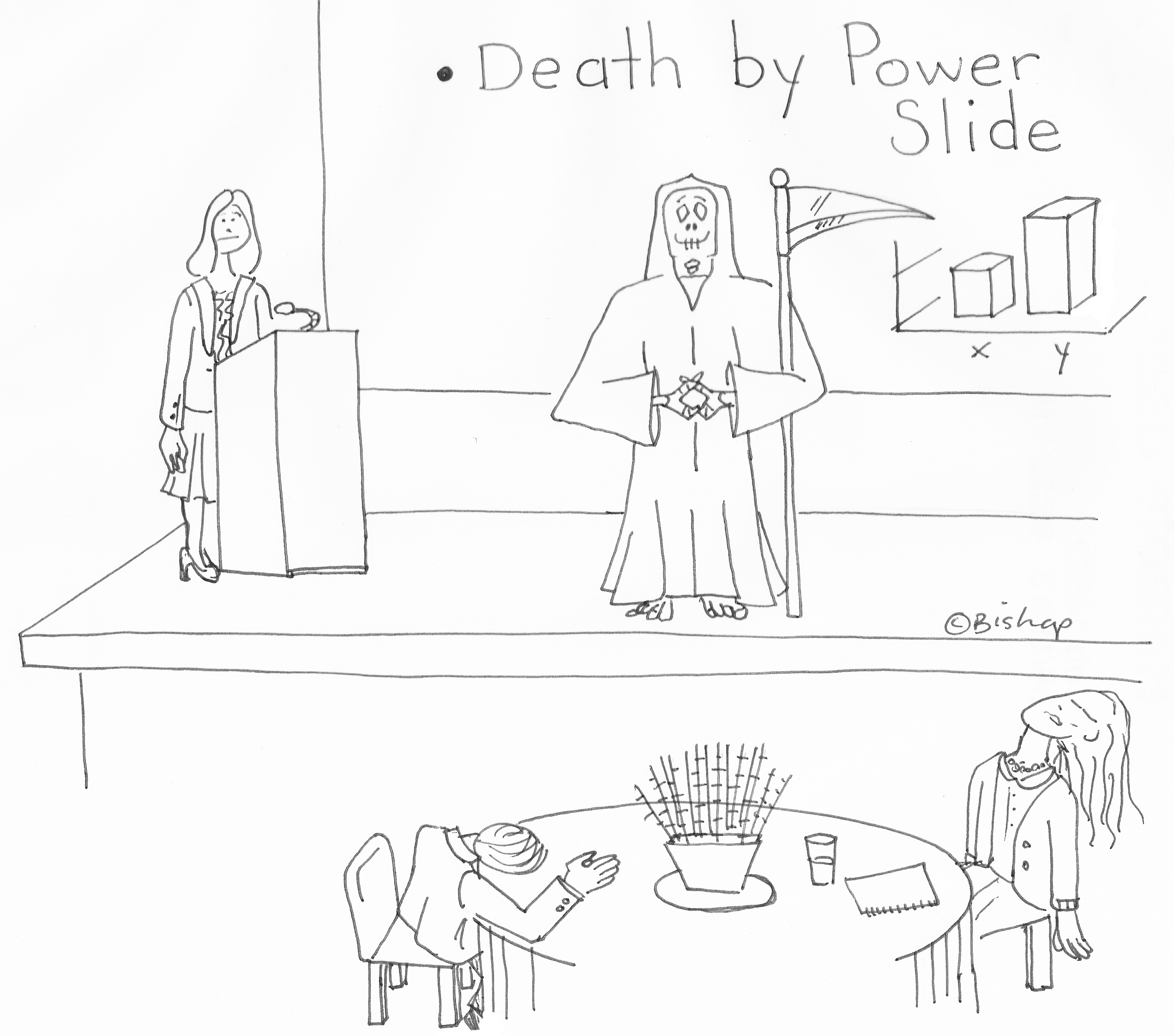
Death is satisfied to see that death by PowerSlide (PowerPoint) is possible!

Making all your idioms come true!

By Jeffrey Bishop

Tell Time: 1 minute
Scare Rating: 2 of 5 Ghosts

Janice stood behind the podium, as still as the bronze sculpture that stood in the foyer outside the hotel meeting room. Shock and disbelief had stunned her.

“I don’t know why you’d be surprised. Many have predicted this possibility. But your success in taking it from the theoretical to total success is awe inspiring. Truly fantastic.”  Death, in his full blackness, stood center-stage, framed by the bright PowerSlide presentation projected on the large screen behind him. He was admiring the carnage.

Janice slowly turned her gaze from Death to the small auditorium. At every table, bodies lay slumped over, eyes open and tongues lolling out. Though Death had delivered the final blow, her words, her ideas, her slides, her presentation had been the instrument that had laid the audience low.

“Death by PowerSlide,” mused Death. “Amazingly possible!”

THE END
Copyright 2013

Bonus content!

Gravesite Locator

•October 1, 2013 • Leave a Comment

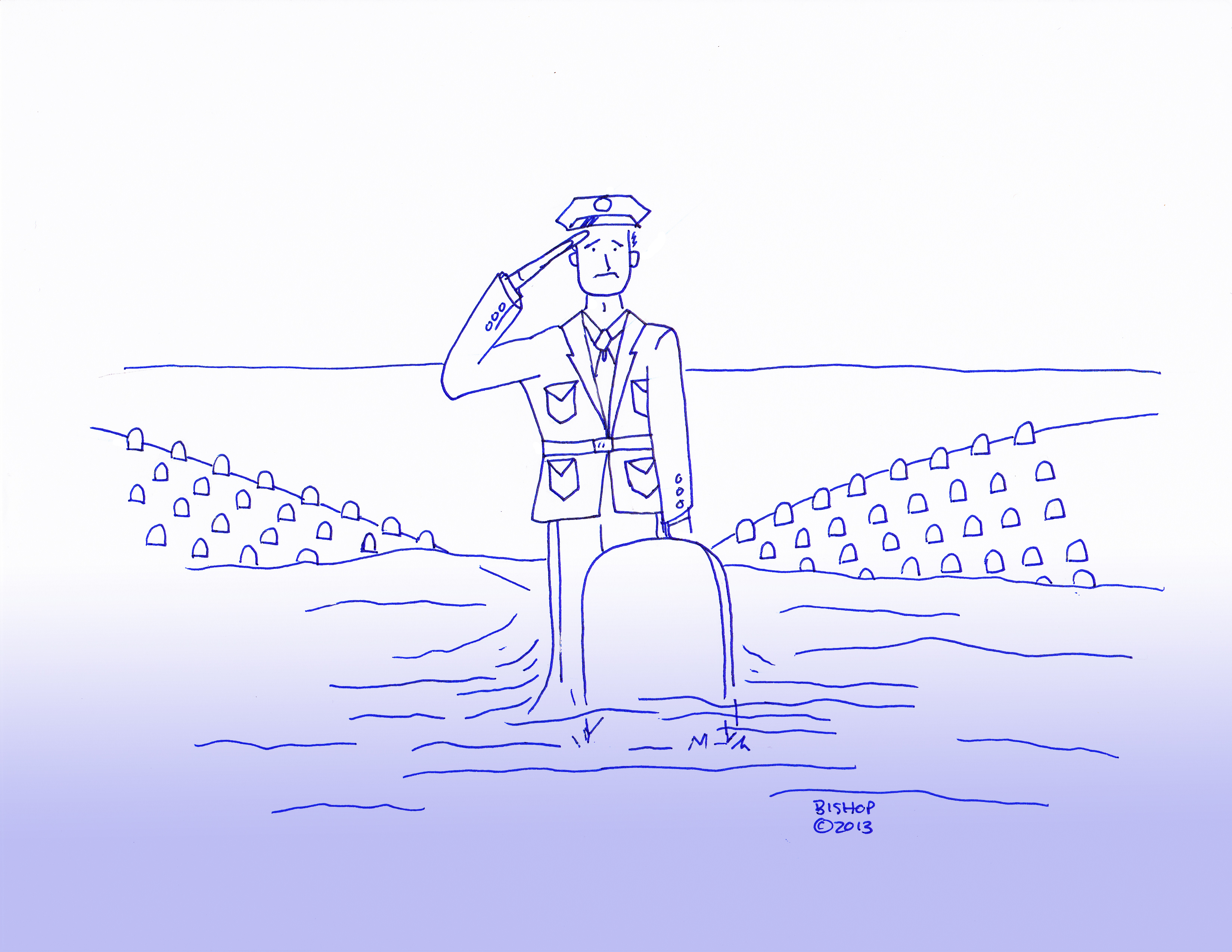
Soldier gives final salute at grave side

By Jeffrey Bishop

Tell Time: 6 minutes
Scare Rating: 1 of 5 Ghosts

It was the kind of a day better spent curled up in a blanket with a book and a cup of tea than on an outing — especially an outing to a national cemetery to visit the final place of rest of a beloved grandson.

Besides the bitter mood that the task presented, the palpable drear was due to the rain; or what some might call “not rain:” a fine, cold, ever-present mist that consumed the space between the molecules of air and made it as dense as any real body of water.  This was made clear to Doug and Gloria Hammerschlicht as they hustled from their car to the stone pavilion just inside the Veterans Cemetery gate.  The short trip had soaked through the couple’s clothes, and, it seemed, through their flesh, to chill their very bones.

“It does look like it wants to stop,” remarked the woman with purposeful good cheer.  “The sun is trying to peek through the clouds!”

While she examined the skies optimistically, Doug strode to the electronic kiosk against the pavilion’s solid stone rear wall.  He ignored his wife’s comment by pretending to be fully engaged with the touch-screen kiosk’s gravesite locator application.  He was focused on a single purpose: finding his grandson’s place of eternal rest.

“Here it is: Adam Hammerschlict, PFC, U.S. Army.  Born May 18, 1991.  Died in Service to his Grateful Nation Sept. 7, 2013.”

Gloria had caught up to her husband, and held his arm for support; support for whom, it wasn’t clear.

“Just 22,” she whispered.  “Too young.”

Doug cleared his throat and wiped his eyes with his out-spread thumb and middle finger.  “He’s at plot A117 PQ,” he said as he whipped his smart phone from its holster on his hip and scanned the QR code on the screen.  This action captured the location and a map with GPS coordinates.

“Let’s go.” He started to turn, to lead the way toward their grandson’s burial place.

“Pardon me, Sir, Ma’am,” came a quiet but clear voice.  The elderly couple jumped with surprise; they had thought themselves alone under the pavilion. “Can you help me find something?”

They turned toward the voice to find a tall, sturdy young man in full Class A military uniform standing before them. The clothes fit well and were in inspection order, but were drab in color, perhaps owing to the bleak lighting. They also, to Doug, seemed to be of an older style than that which their grandson had worn.  But Doug had never been a military man, so he couldn’t say for sure if it wasn’t because they represented a different branch of service.

“How can we help you?” Doug offered.  He seemed grateful for a diversion from their present heavy task.

“I’m trying to find a gravesite.  Do you know where Private Henry Arnold’s body rests?”

Doug whistled between his teeth as his eyes passed over the thousands of identical white marble tombstones in perfect formation across the somber hillsides around them.  Of course he didn’t, but he could find it the same way he’d found his grandson’s.

“Private Arnold, y’say?” he asked as he turned back to the kiosk.  “I don’t have a clue, but this thing will tell us.”

The older gentleman deftly maneuvered his spry fingers across the screen.  He briefly puzzled over why his younger contemporary hadn’t bothered to use the technology himself. “Either too lazy or too stupid,” he muttered to himself.  One of those two answers resolved the matter to his satisfaction, and he refocused his full attention on the task at hand.

“Found it.  It’s in A98, just over the next hill,” said the man.  He looked up and saw that the information seemed to have lifted a heavy burden from the weary young man’s shoulders.  Doug’s heart softened at the sight; the lad was really only a boy.   Just like their grandson.

“Anyway, we’re headed just beyond that way, if you’d like to join us,” he offered.

“Oh Doug, the sun is out.  We should walk!” Gloria interjected.  The man looked out across the soggy fields; the sun shot shafts  of blessedly bright sunlight into the otherwise depressing scene before them.  The mist evaporated from the air, and the rolling fog, still heavy on the rolling meadows, glowed softly against the dark background of the surrounding woods and distant clouds.

“Okay,” Doug agreed.  The soldier was silent and compliant, and fell in behind the couple, as if in formation again.

The walk to the soldier’s stop was short, but seemed eternally long due to the awkward silence.  Gloria — but not Doug — might have wanted to talk, if only to fill the space between them that the silence created.  But she had her own grief on her heart, and besides, she didn’t know what she might say to the boy about his loss.  The boy also showed no desire to engage in conversation; he seemed intent upon his mission: to find and visit the gravesite of Private Arnold.

“There it is,” Doug said.  He stopped in the road and pointed to the row of tombstones one row up and on the left.  “Third one over.”

“Thank you Sir.  Ma’am,” the young soldier said.  The formerly somber face now seemed to beam, as if joy had descended upon him at the opportunity to complete his errand.

The soldier wheeled away from the couple with a sharp military facing movement.  In the emerging sunlight, the woolen uniform seemed drab and all the more out of place.  Or perhaps, out of time.  Doug shrugged subconsciously and resumed walking up the path, with Gloria on his arm.

“Polite young man,” she remarked

“Mmmhmm,” muttered Doug.  There was something about the lad.  They topped the rise of the hill, and he stopped.  He turned back quizzically.  The soldier stood before the grave, with fog shrouding his lower half.  He was apparently reading the headstone.

As the couple looked on, they saw the soldier’s figure walk forward, and also, it seemed down, as if on a staircase into the grave itself.  The fog rose and swallowed the scene, briefly, rendering the boy invisible.  In the very next moment, a strong breeze blew between the rows of tombstones, scattering the last remnants of fog that the sun hadn’t yet burnt off.  In its wake, the soldier had disappeared.

The couple, in awe, looked at each other to verify what they were seeing — or rather, no longer seeing.  The young soldier had plainly disappeared into the grave.  He had returned to his rightful place of eternal rest.

The couple lingered a bit longer, considering the implications of what they’d experienced.  Then they turned to finish their own important errand, at peace for the first time in a long time, knowing by what they’d seen that their own beloved lost soldier surely also would eternally rest in peace.

THE END
Copyright 2013

Click the link to access the Department of Veterans Affairs National Cemetery Administration’s digital gravesite locator, OR click the smartphone image below to access the site it on your mobile device:

Mobile device showing National Gravesite Locator

Inspiration:  Jefferson Barracks National Cemetery, St. Louis, Mo.:

Jefferson Barracks National Cemetery on a morning with light fog burning off

News Report Shows Life Follows Art Via ‘Suri-Cide‏’

•September 27, 2013 • Leave a Comment
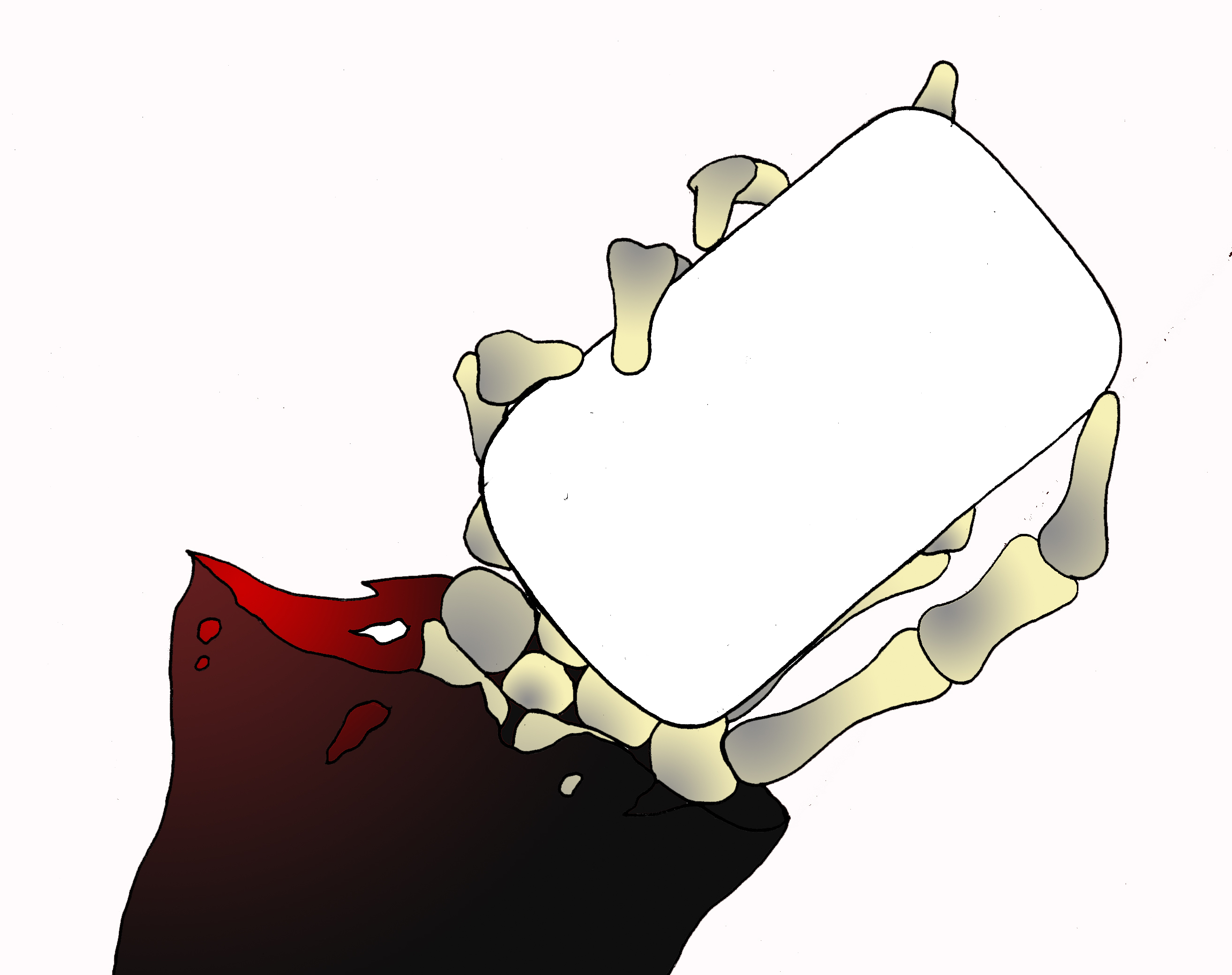
Skeleton holds smart phone with "deadly" GPS app

Death App?

By Jeffrey Bishop

File the following news story under the heading: We tried to warn you!

Though our account shows 1) pre-meditated intent, and 2) is technology agnostic and 3) completely fictitious, there nonetheless are eery similarities between a Siri-ous map-function incident — an Apple Maps glitch that sent drivers across an active airport taxiway in Fairbanks, Alaska — and the murderous main thread of our Suri-Cide story.

Did we predict the future in this true-to-life, life-follows-art case? Mere coincidence? You decide …

We’re just thankful no one was hurt.

Yet.

THE END

Copyright 2013

The Youth Mongers

•September 25, 2013 • 2 Comments

Alien drains life essence from an intern to consume his daily habit

News reports across America are shouting that interns are being taken advantage of.  But not like this!

By Jeffrey Bishop

Tell Time: 5 minutes
Scare Rating: 2/5 Ghosts

“Send Hank, your intern, up to see me,” the boss’ voice bellowed from Jerry’s speakerphone. The manager looked across the office to where the young college student sat in a small cubicle. The intern had heard the order, and stood up to go. On his way out, he looked back at Jerry; his expression conveyed his thought simply and clearly, if silently:

“Help.”

~

Jerry sat across from Bob and Cheryl, fellow managers and professional confidantes in their shared suffering and success at Xenon Corps. Usually the banter was trivial — about office gossip or which of them had the best odds of moving up a rung on the corporate ladder first. But the conversations of late had been much heavier.

“It happened again today,” Jerry said with clear exasperation. “Every day, at some point, the old man takes my intern for an hour or two. The kid’s energetic and hard-charging all day, up to that point, but when he comes back, he’s drained of all energy and life.”

“Probably the boss is testing new speeches on your intern,” quipped Bob. “You’ve heard the old man drone on and on about new policies and procedures at our town hall meetings.”

“I know, right?” added Cheryl. “The animal cruelty folks would be very interested in this case if they knew what he was being subjected to!”

Jerry’s one arched eyebrow conveyed real concern — and no interest in jokes on the matter.

“What in the world do they talk about?” Bob added, more seriously.

“That’s the thing; I have no idea. I’ve asked my intern and I’ve asked the boss, but all I get from my intern is general statements about ‘mentoring,’ and all I get from the boss is baloney about ‘investing in the youth of this company and the future of our planet.’ Pretty high-minded fluff that doesn’t help me get work done and that doesn’t help Hank build a résumé. I lose him for that time, and for the rest of the day as well, because he’s worthless and drained from that point forward!”

“Whaddya gonna do about it?” asked Cheryl”

“I don’t think I can do anything,” said Jerry.  “I guess I’ll have to lump it. But I don’t like it.”

Sooner than he thought, Jerry got a chance to no longer lump it. And though he was glad for it — and for Hank — he still prayed daily to forget all that he’d learned.

~

“Send him up, Jerry!” barked the boss across the phone line. Hank was looking rather haggard compared to the fresh, exuberant young man who’d started with the company only a couple months prior. As always, he complied — as much as he dreaded the now-daily “face time” with the executive, he needed the experience on his resume. He couldn’t risk a bad recommendation. Not after all he’d given over the summer

“Oh shoot, Hank, take this with you — it’s the Langstrom contract. We need to get the boss’ signature on it and get it couriered across town by noon.”  Jerry’s request was met by silence; Hank had left before he could stop him.

Jerry got up and headed toward the elevator to try to catch up with Hank. He strode into the executive suite. Alice, the receptionist, was away from her desk, but Jerry could hear the boss addressing his intern on the other side of the heavy mahogany door to his office.

“Let me just pop in for a second and take care of this,” Jerry said to himself. “And I can see what they talk about for all this time, too!” he added under his breath.

Jerry tapped lightly on the door, then twisted the handle to enter — as he’d seen Alice do countless times. What he saw on the other side was mortifying.

As he entered the room, he approached from behind a large, green insectoid-like creature standing over Hank, who was seated facing the large desk. The thing wore a dark suit and a red power tie, and it’s voice sounded strangely like the boss’, but with a raspy, metallic clang on random syllables.

“You interns, with your youth, are so precious,” said the creature. It’s tendril-like antennae danced rhythmically in time with the speech. “You have boundless energy, and we are soooo hungry.”

Jerry was spellbound. His paralysis broke into action when he saw the monster slide a large vial from the young intern’s neck. It raised the vial to its mouth and poured the contents — a purple liquid that gave off a strange green-blue glow — into it’s many-pincered mouth.

“Noooo! Stop!” shouted Jerry, reflexively. The monster swung around in surprise and let out a high-pitched, guttural yell.

“Let the boy go!” shouted Jerry again. He strode toward the duo, knowing that he must do something, but with no plan at hand. His adrenaline was pumping hard, and the entire room disappeared in pure, dry white except for the dangerous scene before him.

The alien critter let out another carnal yell and took a swipe at Jerry with a claw-like hand. Jerry felt pain deep in his skin — did it cut through to bone? — a pain that helped him clear his head.

The next swipe came from the other arm, but Jerry saw it early and easily dodged it. In his retreat, he rolled toward the desk and when he rose, he found an opportunity. On the leader’s desk was a heavy antique brass telescope. Jerry swiped it up and swung it baseball-bat-like into the ant-thing’s head.

The blow went deep into the monster’s central nervous system, causing its legs to buckle and sending it face-first into the deep-carpeted floor before the desk.

Exhausted and shaking with bio-chemical-induced energy, Jerry turned to a groggy, disoriented Hank. The youth was okay. Jerry steadied himself against the dark-stained desk behind him and tossed a weak smile to his young protegé. They would be alright, the look said.

Moments later — many minutes too late, Jerry thought — the room filled with a covert special ops SWAT team, which covered over the dead thing while another group quickly whisked the office workers from the room and into a black van parked at curbside.

As they were taken away for interrogation and memory remediation, Jerry heard the lead commando grunt:

“Nards! It’s a Xenonite!!”

THE END
Copyright 2013

Monsters in Marketing

•September 20, 2013 • Leave a Comment

by Jeffrey Bishop

Madison Avenue, move over.  The maddest men of them all, the dark denizens of nether realms, have started to take over the airwaves in many hideous forms, in a slew of new marketing campaigns that cater to our darkest desires.  Follows is a list of current faves airing now or recently.  We only found 12, and what Scurry Tails list would stop before 13?  Did we miss any?  You be the judge (And jury.  And of course, executioner!):

Zombies schilling for Sprint

The Devil sells Mercedes’ … for the price of your soul

Vampires hawking NutriGrain breakfast

As a side note, vampiress Mrs. Morton is played by Gillian Vigman, an infamous (“more than famous”) actress previously unknown to our family by name but otherwise familiar and ubiquitous by her work for Hanes, Jack in the Box, 1-800 Contacts, Direct TV, Swiffer and many others — almost all appearing on television in the same time frame!

Dracula is happier than a GEICO customer to promote their insurance

Do the living dead enjoy brain-flavored Starbursts?

Volvo knows:  Once upon a time, Little Red Riding Hood and other fairy tales were considered horror

Sasquatch messes back

Phil the Vampire — yes, the GEICO vampire — likes his Sonic burgers rare.  Very rare

Open up.  It’s Bill.  Bill from Hell.  It’s also Frankie the (Geico and Sonic) vampire

Wheat Thins asks:  Are we having fun, Yeti?

For nostalgia’s sake:

Elvira’s got a punny way of selling suds

And finally, our hometown favorite:

Dawn of the Last Dorito 

Parental advisory:  A couple language tidbits in the bloopers of the following:

Which is your favorite?  We’ll be watching for new ones as we lead up to Halloween! 

THE END

Copyright 2013

For Whom the Beep Tolls

•September 17, 2013 • Leave a Comment
Watch shows that his time here has come to an end.

It’s time to get ill.

“Just remember, once you’re over the hill you begin to pick up speed.”
– Charles Schultz

By Jeffrey Bishop

Tell Time: 3 minutes 30 seconds
Scare Rating: 1 of 5 Ghosts

Mike wore the same watch his entire life. It was the watch his father gave him on his 16th birthday, and at the time, it was rather sophisticated, with a dozen features, weather hardening and illuminated visibility in all conditions, day or night. It quickly became very special to the young man.

When he first set it up, he programmed it to chime on the hour. In his youth, it seemed as if a lifetime passed between beeps.

When Mike went off to college, he saw no reason to change his watch. Money was tight and a new watch was a luxury he couldn’t afford. Besides, the instrument was still relatively new, and he liked it a lot.

Upon graduation, his dad offered him a new watch. A watch is a practical thing, and Mike was a practical young man — his practical nature exceeding that of his wrist-worn tool. So he stayed with the watch of his youth and invested the allowance in stocks instead.

The beeps continued on, reliably present, but in the background only, like an ever-present thought in his subconscious.

As he grew in his career and started his own family, he changed his watch batteries a number of times and a strap now and again. But he never changed his watch. He didn’t need to. And, he didn’t want to.

On a singular day in his middle age, for the first time in years, Mike took notice of the regular beep of the watch. The chipper chirping seemed to come much more frequently to him. Hours seemed to pass much more quickly — to Mike, they now seemed to mark just quarter-hour increments, although that was an absurd notion, which the timepiece proved: the watch face always showed the top of the hour when he reacted with a glance. The accelerating passing of time was a common phenomenon that many of his middle-aged friends also commented on.

At his retirement, Mike’s boss offered him a beautiful gold-filled watch, of a distinguished brand. The watch was something to be treasured, according to the certificate that was read in his honor:

“This gift symbolizes the many years of faithful and dedicated work, enormous contributions, and lasting legacy that your years of service have provided the esteemed company, our noble employees and its many shareholders.”

Mike accepted the watch graciously. He shook his boss’ hand, kissed his wife and bid farewell to his co-workers. The watch stayed in its velvet-lined box on his home-office desk, serving as a paperweight or an occasional conversation topic when a friend or family member paid a visit. But he never wore it. He still had his first watch. His only watch.

The frequency of the watch’s subtle chime had quickened; the beeps seemed to come like heartbeats now. This couldn’t be the passing of hours, as it had been. No, the watch was telling him something different now. An unknown feature had been activated. Or discovered. Or, created, from the symbiotic life-long relationship between man and a machine. Mike’s watch was now a timer, not a timepiece; synchronized with his life force, the accelerating beeps negatively correlated to his dwindling remaining time.

Mike never gave the watch a look anymore; he let the beeps confide to him the constant passing of time.  And of life.

~

The loud, steady beep brought Mike’s wife into the couple’s living room. She knew before she arrived what she’d find.

There, her husband lay still in his armchair, his head drooped onto his chest, the newspaper on the floor beside him, just inches from the cold fingertips that had held it only moments before.

With a single hot tear escaping her eye, she lifted his arm and found the watch. She gently pressed a thin button on the side of the case, ending the steady beep. And forever extinguishing the light on the face of the man’s faithful, constant companion.

THE END

Copyright 2013

The Money Tree

•September 11, 2013 • Leave a Comment
A household money tree. Money perhaps CAN grow on trees!

It’s not that money CAN’T grow on trees …

It’s not that money can’t grow on trees …

By Jeffrey Bishop

Tell Time: 7 minutes
Scare Rating:  3 of 5 Ghosts

“Money doesn’t grow on trees!” That’s what Rupert’s mom loved to remind him whenever he’d ask her for help.  Lately, down-on-his-luck Rupert had heard it a lot.

Rupert wasn’t bad, really; he was just young and a bit dim-witted, and had been somewhat coddled up to his 20th birthday by his mother.  Thus, he had not yet made the connection between sustained, hard, quality work and continued employment and pay.

He wasn’t quite sure what had gotten into his mother lately; she had suddenly stopped the one-way flow of support that had welled from a spring deep in her heart and ran toward him from the day of his birth.  Why that spring ran dry was a mystery to Rupert alone; he attributed it to a drying up of his mother’s love and affection for him.  But rather, it was precisely because of her overwhelming love for her son that she finally, fully cut him off from any tangible support:  no allowance, no lodging, no food (save for Sunday dinner), no laundry.  Nothing but love and encouragement.

He didn’t see things exactly that way; as the bills mounted on his dinette table or when he hunkered down quietly in his easy chair whenever the landlord came by for the overdue rent, Rupert felt more and more lost and desperate.  He felt like he was drowning; he needed a lifeline.

“Where can I get some easy money, fast?” he muttered to himself.

“Maybe I can help?” came a voice from across the room.  It was a thick, dark, powerful voice — it floated heavily across the room like the sickly sweet smell of cigar smoke.  Rupert looked up in surprise; he thought that he was all alone in the small apartment.

Standing across the room was a tall, lean figure; he faced away from Rupert, in contemplation of a framed poster hanging in the lad’s living room.  He wore a suit that, to Rupert’s untrained eye nonetheless looked very expensive, fashionable and well-cut. The man turned toward Rupert and offered a sincere, if dark smile — the toothy grin of a hungry crocodile.

“Who are you?  How’d you get in here?”

“That’s not important,” the man replied.  He wore a Van Dyke-styled beard, which he absentmindedly stroked as he spoke. “What matters is that I have what you need.  And you might have something for me.”

“What is it that I need?” challenged the young man.

“Well, I know that your mother doesn’t think it grows on trees.  But I happen to know that it does,” replied the man glibly. He displayed mannerisms of a cat that has successfully cornered a small mouse.

“Ok, so you know that I need money.  Who doesn’t need money?  What’s it to you?” The youngster was intrigued, but still puzzled at how the man had gained access to his apartment without him knowing.  Maybe the landlord had let him in.  Regardless, if the conversation didn’t get to its point soon, he’d throw the well-heeled guest out the door.  The man must have sensed this, because he quickly introduced his thesis.

“You need money.  I have a money tree.  Yes, a bona fide money tree,” he said to the boy’s derisive snortle.  “You may not have any money, but apparently the U.S. government has plenty to spend on obscure and useless science projects, like growing hamburger meat in a petri dish.  Or, as it were, a live tree that bears U.S. currency as fruit.

“Just such an invention is in my possession. I’m willing to part with it — to give it to you — for just a trifling.  I know you have needs today, but what of your needs tomorrow and for the rest of your natural life?  Wouldn’t you rather live a luxurious life of plenty, at no expense to you in labor or time or effort or creativity?  Or do you want to toil and work for a pittance and struggle to meet basic earthly needs all the same?”

The words he heard whet the young man’s appetite.  He liked money and the things it could buy.  He hated work, and hated being subservient to anyone but himself.  He mouthed at the bait on the hook, tasting it, but with lingering caution.

“What’s the catch?” he asked.  “What’s it gonna cost me?”

“Oh, very little to you,” the man said sincerely.  “I want something that you don’t now value in the least:  your eternal soul!”

A nervous laugh escaped the young man’s lips.

“So what, you’re supposed to be the devil?” he asked.  “Only the devil is interested in souls.”

“Well, there’s another … ” said the devil, but he didn’t finish that thought aloud. “Yes, to your simple understanding, that is what, or whom, I am.”

“Well since I don’t really believe in you, then I don’t really think I have anything to lose,” said Rupert with all the cunning he could muster.

“Precisely,” was the reply.  A large, wide smile spread across the suave man’s face.  Behind the Cheshire grin a mouse sat waiting to be swallowed.  “So we have a deal?”

“First, show me this tree,” Rupert insisted.

“By all means,” replied the man.  “Look behind you.”

In the corner near the patio window — a corner that had been empty before — sat a potted tree, not unlike a ficus.  Rupert approached the tree to examine it.  As he lifted the leaves, he saw a few dozen drab green fruits hanging in various stages of maturity.  The unripe fruit was small and dark and coiled into a funnel shape.  But the larger fruit was flat or only slightly curled, and Rupert could clearly see denominations of $5, $10, $20 and even $50 and $100 bills hanging from the tree in varying stages of maturity.  Each one in legal tender.

He snapped a bill off cleanly and held it up to look at it closely.  The hologram of President Grant on the $50 bill shone through from the backside in the light.  He felt the paper between his fingerprints; it felt like the cotton-hemp of any other crisp, new bank note he’d ever held.  He even sniffed it, and found that it smelled like new money, perhaps with faint citrus notes as well.

The tree was heavy with fruit, and new buds seemed to erupt at every moment, while mature fruit started to fall gently to the ground, forming a pile of money at the base of the tree.

Rupert slipped the large bill into his pocket.  He was satisfied.

“Deal,” he said.  The devil’s grin grew even wider — impossibly so.  That was all he longed to hear; he snapped his fingers, and the youngster felt a quick, sharp ripping pain from his chest.  It was over quickly, and Rupert felt a chill on his insides. The devil drew a silk scarf from his breast pocket and dabbed at the corner of his mouth, as though he’d just finished a delicate, savory meal.

With a sense of satisfaction, he turned on his heel and made for the door.

“Enjoy life!” called the devil as he let himself out.  “I know I do!”

~

The young man was famished; he needed something to fill his empty insides.  He thought that food would do it.

He scooped up a few more bills from the floor beneath the tree and headed out the door and toward the Quik-e-Mart around the corner.  He scooped up dozens of snack pastries, a frozen pizza and a quart of ice cream.  He carried his heavy shopping basket to the counter, where the checker totaled his purchase:  $52.98.

Rupert was glad at the thought that he could finally make such a large purchase, and could do so without help from his mother. He reached into his pocket where he’d stuffed the new bills, but instead of cash, he felt a cold, sticky wetness.  He jerked his hand out and found it covered with a green, moldy slime.  He didn’t know what it was, but it was getting on his new money.  He put his hand back into the pocket, deep, and pulled all of its contents out and onto the counter.  There, in a flat, wet, rotting mess, was the money.  Rupert picked through it, and realized that the money wasn’t in the mess; but that it was the mess.  Before his eyes, he saw green, fuzzy mold grow over Grant’s proud face, consuming the dead president and turning the last bit of the currency into the same rotted fruit pulp that the other bills had changed to.

The fabled money tree had indeed borne fruit, but of a decidedly deceptive and wickedly rotten variety that again brought low a proud. young man.

THE END

Copyright 2013

Superstitions Abound on Friday the 13th

•September 9, 2013 • Leave a Comment
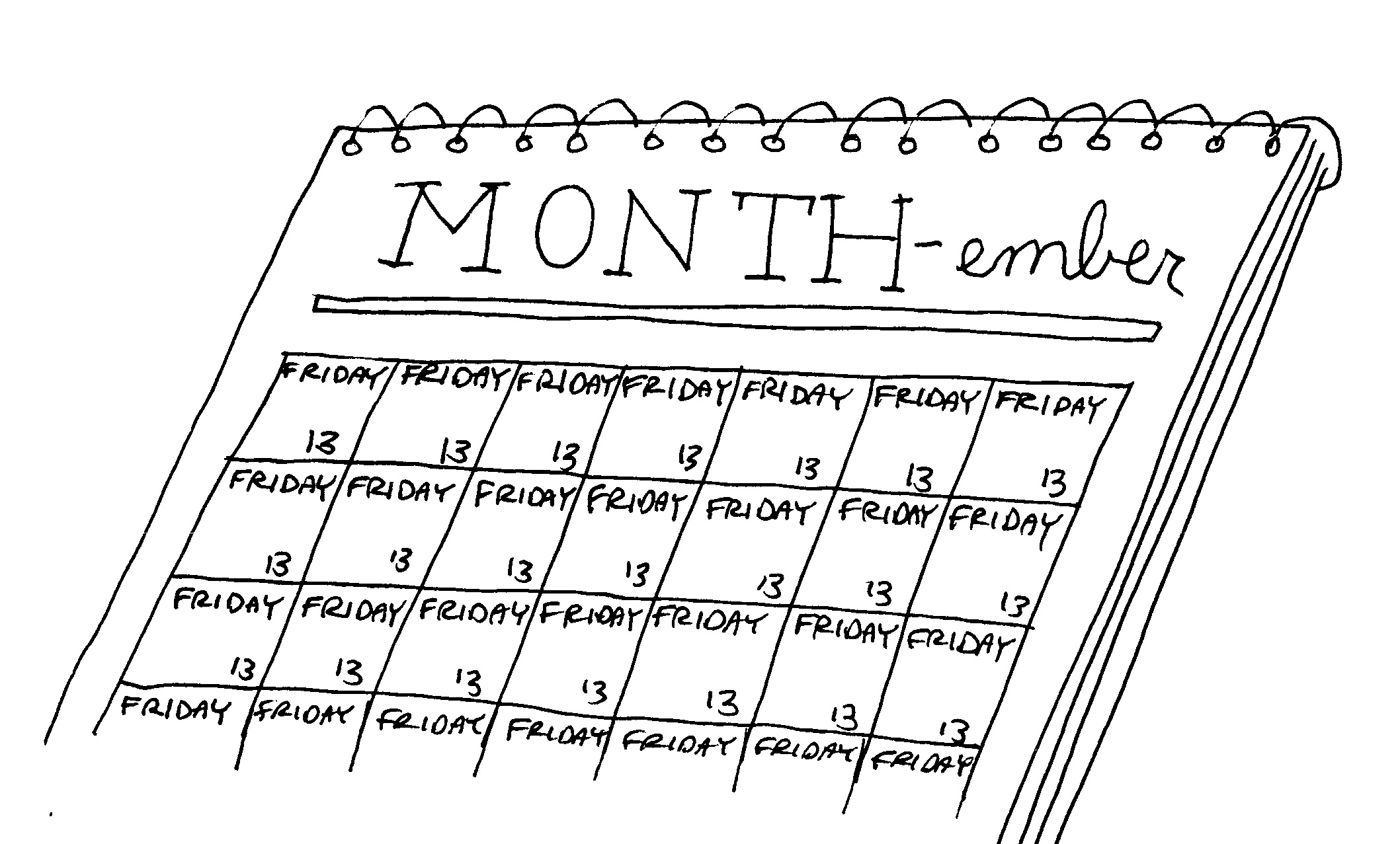
Calendar with every day as Friday the 13th

Bad luck abounds!

This Friday, Sept. 13, marks one of two occurrences of this unlucky day in this unlucky ’13 year (the last occurs Dec. 13).  The following article first appeared in The Airscoop, the official installation newspaper of Vance Air Force Base, in February 1998, when I was stationed there as a public affairs journeyman. Enjoy!

by Jeffrey M. Bishop

VANCE AIR FORCE BASE, Okla. – For the superstitious, 1998 could be a very unlucky year, as Feb. 13 is the first of three Friday the 13ths in 1998.

Many of the superstitions modern western people hold dear – including the beliefs that 13 is an unlucky number, our human fates are tied to the patterns of the stars and black cats are evil – originated more than 5,000 years ago in the Middle East, specifically, in Mesopotamia, according to Dr. Michael Seth, professor of history at Phillips University in Enid, Okla.

“The fact that everything is sevens, 12s and 40s in the Old Testament, of course, is because those were considered good or lucky numbers in Mesopotamia,” Seth said, “and so you see them over and over and over in the Bible.”

Because 13 came after lucky number 12, it was associated with evil.  “There are a lot of legends going on about the twelve apostles of Christ, and that the 13th member at the last supper was bad,” Seth said, “but these would be much later ideas, after the number 13 was already established as bad.”

In addition to continuing the belief that 13 is unlucky, Seth pointed out that people still believe in “lucky number seven,” especially in games of chance.

“Although these are really ancient Middle Eastern superstitions and beliefs, we still kind of like them,” he said.

According to Capt. Wendi L. Betz, behavioral health chief here, superstitions are formed when people erroneously draw connections between neutral phenomena and good or bad events in their lives that immediately follow those phenomena.

“Who knows how our superstitions got started in the beginning, but maybe somebody had a black cat cross their path, and then something bad happened to them, so they connected the two,” she said.

For the most part, Betz said, superstitions are a normal response to our often-random world.  She added that even animals have been shown to display superstitious learning, citing pigeons that developed elaborate “rituals” designed to elicit a food reward during a controlled experiment.

Betz said humans invent their own rituals to create a desired result or to stave off an undesired result.

“I’ve seen some guys on the softball team that have a certain warm-up routine they do every time, or there are the people who play bingo, who bring all their lucky dolls and stuff with them,” Betz said.

Superstitions in a culture’s collective consciousness can be self-perpetuating, because people look for anything that can support their belief in the superstition, she added.

“If you have a superstition about Friday the 13th, you’re going to look for something bad to happen to you that day, and you’re going to pay attention to it (if it does occur),” Betz said.  “Bad things can happen on other days than Friday the 13th, but that doesn’t count, because it doesn’t reinforce any belief,” Betz said.

“Then again, maybe black cats and Friday the 13th are bad, and they’re actually causing bad things to happen to people,” Betz added.

“But I have my doubts.”

###
(e.g., THE END)

 As a product of the U.S. government, the article is in the public domain, and may be reprinted.