The Wrong Fear

•September 18, 2012 • Leave a Comment
Mosquito

A bloodsucker at work. Technically, this is our first-ever vampire story.
Original photo by J.J. Harrison / Creative Commons

By Jeffrey Bishop

Tell Time: 4 minutes
Scare Rating: 2/5 Ghosts

Christian was in the middle of his bedtime ritual — or at least the modified version he used on camping trips. The bedroll was smoothed out and straight across his cot. All zippers had been checked — twice — to ensure they were securely closed against any bugs or other woodland creatures that might want in overnight. A full canteen of fresh water was at arms length beneath the cot.

Christian was busy laying out his clothes for the next day when his headlamp beam illuminated the one thing that all his preparations were geared to protect him against: a small brown spider, toiling away at a tiny gossamer web in the top corner of his tent.

The boy froze, and so too did the spider, caught in the blue-white light from Christian’s lamp. The boy’s panic welled up fast, rising like a flood within the lad’s small frame. When the fear reached his throat, a loud scream escaped, which seemed to knock the boy off his feet.

The spider also reacted. It hissed a small — but perceptible — hiss toward the boy, then stalked forward on his invisible guy-wires in the tent, directly toward Christian where he had fallen. As he neared, the boy noticed that the spider was also growing; it was now almost certainly the size of the boy’s hand.

The boy screamed again, calling for help in between frantic gulps for air. At the fresh bellows, the spider recoiled, and Christian grabbed ahold of the momentary pause to turn and paw at the tent’s zippers, which were supposed to keep such terrors away. He needed all the time he could steal from the advancing menace; after only spreading a hands-width apart, the zipper had taken a bite onto the nylon placket that ran along side of it.

Finally! Zrrrrrrrrrrrrrrpp! came the sound of the zipper around the arch-shaped doorway, as Christian finally made the mechanism work for him. Trying to run through the opening, he instead fell forward and scrambled out into the clearing on all fours. He was certain that he’d felt a furry claw swipe at his leg as he fell forward.

The boy got to his feet and turned to look back on his threat. The tent had collapsed around the spider, but looked alive as the creature — which took up as much space inside its nylon cocoon as a large dog might have — squirmed inside the boy’s former temporary abode.

Christian looked around for others — he looked for his father’s tent or those of the other campers they were with, but saw no one and nothing else in the moon-lit clearing. He was alone.

At least he might have hoped to have been; he still had the spider for company. The tent continued to writhe and grow, as the thing within it struggled to escape. That struggle ended with a loud tearing sound, as the monster shredded its shroud with its large, sharp pincers. What emerged from the one-man tent was now the size of a compact car, and it quickly oriented it’s eight-eyed gaze on the boy.

Christian had no screams left. He had to figure out how to escape, or how to defeat the terrible threat before him. Confident of its next meal, the creature slowly stalked toward the boy.

Suddenly. Christian felt a light pinch on his neck; a small bite. With fast-draining strength, he swatted the spot and felt the assailant smoosh under his fingers. He looked at his hand in the beam of his headlamp, and saw a small, flattened mosquito in a splatter of the his own blood.

Growing faint, the boy swooned and fell. He didn’t know where the spider had gone, but as he passed out, he fully realized that the spider was no longer what threatened him.

~

The father looked down on the fever-wracked body of his son as he lay in the well-lit hospital room. He was thankful that the writhing and murmuring that accompanied the boy’s dark dreams had finally stopped. Christian’s father kept his vigil as the boy slipped into the deep but restless sleep that the encephalitis brought. There was no telling if he’d awaken, but the nightmares would come and go until the boy’s health resolved itself in either death or survival.

“It was spiders,” the man said to the nurse who had entered the mesh-curtained hospital bay where the boy lay. “His big fear was spiders. Funny that it was a mosquito, not a spider, that took him down.”

THE END

Copyright 2012

The Dog Box

•September 15, 2012 • Leave a Comment
A picture of the infamous dog box

The infamous dog box

By Christopher Bishop

Tell Time:  1 minute
Scare Rating:  1/5 Ghosts

Once there was a boy named Tom — a Tiger Scout.  He was on his way to his first overnight camp out, and he had with him his dog Buzz.

They were super excited.  Once they were there, they unpacked and the two met with Tom’s troop.  On the way to their area, a car drove by.  Everyone was off the road except for Buzz, who got ran over.  Tom was crushed.

That night, Tom woke up to the sound of barking.  Tom was confused.  The next morning, the troop went on a hike.  The hike wasn’t done until 10:20 p.m.  When they were almost back, they saw a box in the tree next to them.   Then they heard a growl and a door on the box slid open and Buzz — now a zombie dog — jumped out … and he was still playful and nice and cute!

THE END

Copyright 2012

The Haunted Vacation

•September 3, 2012 • 1 Comment

A scary vision from the haunted vacation

By Christopher Bishop

Tell Time:  1 minute 30 seconds
Scare Rating:  2/5 Ghosts

Once upon a time there was a hard-working family.  They had been working constantly for 2 months.  One day they just couldn’t work any more, so the mom came up with an idea.

“Hey, lets take a vacation!” she said.  The dad and son agreed.  So that’s what they did.

After a day of looking for a place to go, they found one.  It was cheap and near 3 ponds and a lake.  On July 21, 1931 they went. It was a three-day drive and an hour ride on a boat.  They didn’t mind though; they were just so happy to go on vacation.

Once they got there, they immediately ran to the door.  Soon all their stuff was set up and they went to relax.

At sunset, they went to their rooms to get ready for bed.  Soon enough, the boy fell asleep.  At 12:50 a.m., the boy woke up to find himself floating.  He was super scared. He was there for at least 10 minutes. then he just fell back on his be.  He looked forward to find a floating torch.  He got up and followed the torch. He couldn’t see any thing but the torch.  All of a sudden, his hearing went out, followed by all his other senses.

In the morning all his senses were working again, he sprinted to his parents room and told them everything that happened.  They didn’t believe him, but he didn’t care.  He started an investigation.  He took all his toy spy cameras and hooked them up around the cabin.

The next morning he looked at the footage.  He saw a figure, but he couldn’t make out who it was.  That night, he stayed up.  He saw a blue fog-type trail.  He followed the trail into a room he’d never been in before — he never even knew it was there.

Boom!  He died just like that.

After that incident nobody stayed there ever again.

THE END

Copyright 2012

Imponderable!

•September 2, 2012 • Leave a Comment
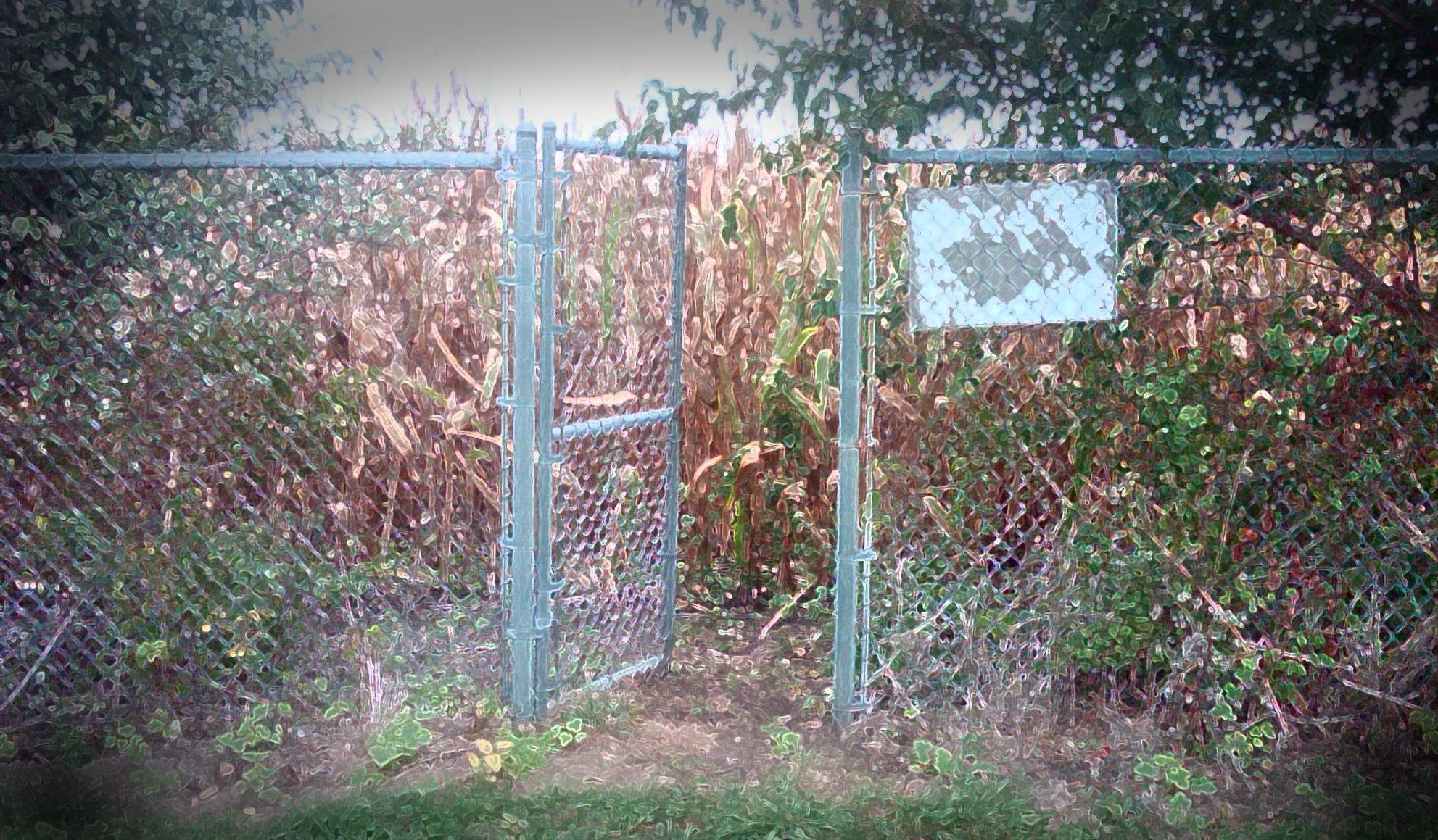
Open gate facing a corn field

Who let the corn out?

By Jeffrey Bishop

Tell Time:  6 minutes
Scare Rating:  1/5 Ghosts

This story is dedicated to David Feldman, the author of a series of insanely informative and entertaining Imponderables books that explain the little mysteries of our daily life — older-edition books that I’m thrilled to discover are still in print, with new ones being crafted all the time.  The main character in this little piece of fiction naturally had to be named Feldman, but there is no further (known) similarity between the character and the real author beyond the intended honor.  The first two imponderables in this story were inspired by actual Imponderables, but the responses that the fictional Mr. Feldman provides might just be Malarky.  Clearly a big-shot author, the real David Feldman nonetheless had the decency to personally reply to me when I wrote to him with an imponderable of my own, for which I am honored.

The children gathered around the campfire with snacks and headlamps and cocoa.  The fall campout always drew a lot of families, and Mr. Feldman’s “Imponderables” routine always drew the youngsters to the fire, where they’d try to stump the group’s master of supposedly unknowable trivia.

“I’ve got one, Mr. Feldman!” said Danny, pumping his arm up and down for the leader’s attention.  Without waiting to be called on, he asked his question:

“Why do clocks run clockwise?” he asked.

“Ooh that’s a good one!” said Jackson, certain they’d get Mr. Feldman this time.  Their confidence faded, however, when they saw a smile spread across his face.

“Clocks run clockwise by definition, and it really wouldn’t matter which way they went — forwards or backwards.  It would always be clockwise according to the clock!” quipped the camp genius.

“It wasn’t always that way, of course,” he continued.  “When the first clocks were invented in Europe in medieval times, some were designed to go forwards — what we call ‘clockwise’ today — and some were designed to run backwards.  But as with things today, as an industry developed around the manufacturing of timepieces, it was decided that some standards needed to be established — and thus, we all go clockwise today.”

“But why CLOCKWISE?” pressed the boy.  “Why didn’t they make counter-clockwise be clockwise?”

“Ah, yes, well there’s some speculation that the direction ultimately chosen reflected the direction that water swirls down a drain, said Mr. Feldman.  “Y’know, the direction the toilet water goes down the drain when you flush!  If the clock had been invented in the southern hemisphere, who knows?  Maybe counter-clockwise would be clockwise!”

“Cool!” said one boy.  “Ewwww! said some girls who sat in a small group at the edge of the glowing fire.  They were all enthralled.

“Tell us the one about where all the rubber from car tires goes after it wears off!” asked Robert.

“Ah yes, a classic!” said Mr. Feldman, rubbing his chin enthusiastically.  “Of course we know that tire rubber wears off; that’s how we get bald tires.  But just as no one really thinks about where all the hairs go when we go bald … ” The boys snickered as Mr. Feldman paused for effect and sheepishly looked up at his own bald pate. “… Few have ever wondered about where the rubber from our tires goes.  But I know.”

“Tell us!  Tell us!” the kids clammered.  By this time, many parents had also gathered around, and they were all eating from his hand..

“Well, it’s really quite simple,” said Mr. Feldman.  “The rubber is everywhere that cars have been.  The tires wear down slowly, and in very small amounts.  Some of the rubber burns up.  Some of it gets added to the roadbed, embedded into the asphalt surface of the road.  A lot of it gets deposited on the sides of the road, blown or washed there from the cars and the road.  And what doesn’t settle there gets caught up in the winds and carried farther away.  It all goes somewhere, but in such small amounts that no one really ever notices it.”

“I thought of one today on the way here,” said Caitlyn, in a soft but clear voice.  “Why do they put fences around cornfields?”. As she asked her question, she swept her arm around the campsite, motioning towards some of the farm fields that were just beyond a windbreak on the north side of the campgrounds.

“Hmmm,” was Mr. Feldman’s only reply for some time.  He was deep in thought, and it seemed possible that they’d finally stumped the maven of the unknowable.  They were certain they’d stumped him when he started to talk though the problem, instead of answering it confidently.

“Now that you’ve mentioned it, it does seem that all fields are boxed in with barbed wire, wood fencing or hedgerows,” reasoned Mr. Feldman.  “Well we can be sure that it’s not to keep the corn IN … That wouldn’t be right now would it?

“But certainly one reason might be to try to keep corn-eating critters out.  Of course, many people have fences to denote property lines.  It’s also likely that the fields are set up for any number of different agriculture uses, including grazing.

“I’m not 100 percent sure of any of these answers,” said Mr. Feldman.  “But I think at least one of my suggestions is the right answer.  I’ll do some research and let you guys know the next time we get together.”

“Ok, party’s over,” said one of the dads.  “Time to turn in.”

With groans and grumblings, kids and adults alike shuffled to use the restroom and brush their teeth before climbing into their tents to bed down for the night.

As a couple of dads doused the embers with water to put the fire out cold, Danny and Jason went into the woods away from the campsite to relieve themselves.  Standing apart from each other, Jason’s whistling stopped as he noticed the cornfield just ahead, beyond the small copse of trees they were in.

Hey, let’s go check out the cornfield — let’s go see if it’s fenced in!” said Jason.

The boys followed the trail to the field, well lit in the rising harvest moon.

“Caitlyn was right!  There is a fence!” said Danny.

“Look, there’s a gate, too,” said Jason.  “Let’s open it up and see what happens!”

The boys unlatched the gate, swung it open, then crept back to the campsite to turn in for the night.

~

The windstorm came up quickly that night, waking everyone in the camp.  Tents shook violently, and it sounded as though limbs and acorns and other tree debris was thrashing the sides of the tents.  No one even dared to peep outside, so terrifying was the storm.

The families awoke to a clear, calm morning.  As children and parents climbed out of their tents to take in the damage, each was awestruck by the sight they took in.  All around the campsite was corn debris:  hundreds of ears of ripe corn lay strewn about.  Corn husks and stalks littered the ground, leaned against the tents, or lay in giant piles around the tent village.  Indeed, no wind damage could be seen; beyond the corn wasteland, the only other damage was a new clear, wide path that led from the campsite to the open gate of the cornfield just beyond the tree line.  A cornfield that was full of ripe corn the day before, but which now looked … abandoned.

Mr. Feldman stepped out of his tent and took in the damage.  His eyes traced the campsite corn scene to the trail in the woods to the empty cornfield beyond.  With robust understanding, all he could utter was …

“Imponderable!”

THE END

Copyright 2012

On the Scurry Tails ‘Tell Time’

•August 13, 2012 • Leave a Comment
Illustration of mystical stopwatches floating in the sky

Time is NOT on your side

By Jeffrey Bishop

This collection of stories has a couple of proprietary features that we’ve employed from the start that we think add significant value to our readers:  the Tell Time and the Scare Rating.  Each is fairly self-explanatory; the Tell Time is designed to give readers a sense for how long it might take an average reader to tell the story to others, and the Scare Rating is designed to give a sense, on a scale from 1 to 5, how scary a story might be to an average youth audience.

With this post, we want to take on just one of the features — the Tell Time — and further explain what it’s for and how it works, while seeking feedback from our readers on how we might employ the feature better (Scare Rating was covered in a separate post).

  • Tell Time helps readers select appropriate stories to read or to tell based on story length.  Generally speaking, shorter stories can be considered to be “better” than longer stories for storytelling, because you don’t have to hold readers’ interest for as long, and because you can tell more stories in the same amount of time compared to longer stories.  Of course this all goes out the window, with plenty of examples of well-told longer forms holding attention just fine
  • To calculate Tell Time, we take the story word count and divide by 200, then round to 30-second increments.  We created this formula by timing ourselves reading aloud about a dozen of our stories at a “normal” pace to determine the average number of words that are read in a minute.
  • We strongly believe that the best campfire stories to tell “weigh in” at less than 10 minutes (click here for a discussion on story length and other factors that aid storytelling).
  • We do have stories here that are longer than 10 minutes in the telling; these are ideal for reading versus telling (click here for a good example).  When we’ve written these, we’ve also edited them for length into “Short Cut” versions to allow for telling (click here for a good example).

Is the Tell Time a useful feature to you?  Do you consider the Tell Time when deciding whether to read a story or not?  Regardless the length, does the Tell Time make you less interested in reading at all?  Would it be useful to categorize stories by “Shorter” or “Longer” for ease in finding all the shorter stories in one place?  Let us know what you’d like to see!

Discussing the Scurry Tails ‘Scare Rating’

•August 7, 2012 • Leave a Comment

Scare Rating:  3/5 Ghosts

By Jeffrey Bishop

The Scare Rating and the Tell Time are a couple of proprietary features that we’ve employed on this site from the start that we think add significant value to our readers.  Each is fairly self-explanatory; the Scare Rating is designed to give a sense, on a scale from 1 to 5, how scary a story might be to an average youth audience, and the Tell Time is designed to give readers a sense for how long it might take an average reader to tell the story to others.

With this post, we want to take on just one of the features — the Scare Rating — and further explain what it’s for and how it works, while seeking feedback from our readers on how we might employ the feature better (Tell Time was covered in a separate post).

  • Scare Rating helps readers select appropriate stories to read or to tell based on how scary the story is.  The higher the number, the more spooky the tale.
  • All Scurry Tails works of fiction are spooky in some way — even the humorous scary stories, although these tend to be slightly less creepy than others.
  • All content on Scurry Tails is kid-safe.  This speaks to appropriate content, but in regards to the Scare Rating, it also means you won’t find anything too creepy here.  There are plenty of other sites for darker, more gory or horrific tales.
  • The Scare Rating is our best guess at how creepy a story is; our accuracy depends on the individual tastes and temperaments of our readers.
  • The target audience for this site is boys and girls from about 8 to about 15.  The Scare Rating is calibrated relative to that age group; however, age is not always the best indicator of temperament — meaning: don’t assume that every 15-year-old can necessarily stomach a story with a 5 Ghosts Scare Rating (but most can).

Is the Scare Rating a useful feature to you? Do you consider the Scare Rating when deciding whether to read a story or not? Would you rather be  surprised by how spooky a story might be and not be informed up front?  Let us know what you’d like to see!

Groans From the Basement

•August 5, 2012 • Leave a Comment
Two monsters look up from the bottom of the basement stairs

The source of the groans from the basement. As imagined in Minecraft.

By Jeffrey Bishop

Tell Time: 6 minutes 30 seconds
Scare Rating: 2/5 Ghosts

New to town, Jake had made a fast friend in Thomas.  By the end of the week, they were getting along so well that Thomas asked Jake to have a sleepover.  Jake’s mom, eager to help her “big boy 4th grader” cement the new friendship, agreed.

With a sleeping bag and clothes stuffed into his backpack, Jake rode home on the bus with Thomas, who let them into his house with the brass key that hanged off the green and orange shoelace necklace he wore.

“Want some cookies?” Thomas asked.  “My mom will be home in a little bit, but she always bakes when I have a friend come over.”

Jake took two cookies and followed his friend through the house, gnawing the chewy oatmeal raisin disks as Thomas dumped their backpacks in his bedroom, fed and watered his dog Rascal, and gave a lay of the land that was his house.

“We’re not allowed on the good furniture in this room,” he said, leading Jake through the formal living room at the front of the house, “but we can eat in the family room, and my parents let me jump on the couch in the family room!”

“Cool,” said Jake, taking it all in.

The two had covered most of the floor plan, and most of the home’s rules, and were heading back to the kitchen for more cookies, when they passed a new door.

“What’s in there?” asked Jake.

“Oh yeah,” said Thomas, suddenly nervous, and bit embarrassed — as though he’d forgotten something really important.  “That’s just the basement.  But we can’t go down there.  Don’t go down there ever.”

“Why not?” Jake asked.

“Just because … because there’s a pair of monsters down there!”  Thomas replied sheepishly.  Jake frowned.  He didn’t need to hear a tall tale like that to follow the rules in someone else’s house.  But he shrugged off Thomas’ tale on the fact that his new friend didn’t know him quite well enough to know that about him.

“Come on, let’s go kick the soccer ball in the backyard,” Thomas said, eager to change the subject.  “But watch out for Rascal’s landmines!”

The duo spent the afternoon playing soccer outside and video games inside before returning back to the yard to climb the big oak tree that shaded the patio and most of the house.  After dinner — tacos –the boys helped clean up the table, then settled into the family room to play the board game while Thomas’ parents relaxed to the television in their own room.

As Jake contemplated his next move — the quick kill of one piece or the strategic routing of Thomas’ entire squad — his concentration was broken by the sounds that rose from the basement.  At first he thought it might be a TV, but the sounds were the same:  A low, guttural groaning sound, followed by a quiet, high-pitched snickering sound.  Jake looked up from the board to his friend with a quizzical look, but Thomas seemed oblivious to the sound.

“Don’t you hear that?  What’s that terrible sound?!”

“Hear what?”  Thomas answered, scanning the board for his best defensive position.  Then he, too, finally noticed what Jake had heard.

“Oh yeah, that; that’s just our monsters,” said Thomas, somewhat nonchalantly now.  After all, he’d already told Jake about them.  “One’s torturing the other.  It’s no big deal.  But remember:  don’t go into the basement.”

“Whatevs,” was Jake’s reply.  He didn’t know for sure what was making the noise, but Thomas’ storytelling was starting to annoy him a good deal.

Jake took out his frustration on the battlefield of the board game, by wiping out all of his friend’s soldiers and cornering his general in the garrison at the far edge of the board.  Now it was Thomas’ turn to be annoyed.

“It’s time to go to bed!” he declared matter-of-factly at the end of the game.  He tossed the board game back into its box and headed to the bathroom to brush his teeth.

In relative silence, the two laid out their sleeping bags on the family room floor and settled in to sleep  While Thomas crashed almost immediately, Jake — in a strange house and worried about his fragile new friendship, couldn’t sleep.  He replayed the conversation in his mind a couple of times, and came to the conclusion that he needed to forgive his friend for the stories he told and let it go.  Doing so was like a magical sleeping spell; almost immediately after deciding to forgive his friend, he was able to sleep.

But the sleep didn’t last for long.  In the twilight of rest — that early dozing state en route to a deep slumber — Jake was yet aware subconsciously of noises around him.  His subconscious mind, hearing noises beneath them in the basement, quickly roused the conscious Jake and told him to pay attention.

Sitting straight up and listening hard now, Jake could hear the same sorts of noises he’d heard earlier.  He heard low mumbling, followed by deep, pained groans and then an also-deep tittering sound that sounded like a throaty giggle.  It was quiet for a moment afterwards, but then it happened again:

“Mumble, mumble, mumble-mumble!”

“Arrrr-urrrh-owhrrr-uhhnh!”

“Eeeeh-eee-ehhh-ehhhh-ehhhhhh!”

Jake couldn’t stand it.  Upset at his friend all over again, he couldn’t stand not having an honest answer about the goings-on in the basement.  He certainly wasn’t going to be able to sleep through the noise, or through his anger.  Because he was mad, he was not at all afraid, and quickly slipped out of his sleeping bag and made for the basement.

Stepping gingerly across the floor, he made it all the way to the basement door without rousing Rascal, who was chasing rabbits in his dreams in his bed in the corner of the kitchen.  Slowly, quietly, Jake twisted the handle of the door to the basement.  He was expecting that creepy foreshadowing squealing sound to grind out from an old set of hinges as he swung the door open, but to his relief, it opened silently — Thomas’ dad maintained the house quite well, Jake thought to himself.

Leaving the door open, Jake stepped lightly on to the first wooden plank step.  It, too, kept his secret.

Whatever was making the groans in the basement was still at it, and Jake marvelled at Thomas’ imagination — it did sound like monsters torturing each other!  But as he crept deeper into the basement, Jake could start to make out what was being said.

“How much mumble, mumble batteries mumble?  Mumble – they’re mumble, mumble charge!”

“Arrrr-urrrh-owhrrr-uhhnh!” came the same pained groans.

“Eeeeh-eee-ehhh-ehhhh-ehhhhhh!” rose the same maniacle, gleeful laughing sound.

Jake got to the bottom of the stairs and slowly peered around the corner into the basement room.  There, in a well-lit and nicely furnished lounge room, two large, hairy monsters sat on soft armchairs facing one another.  The monsters were hideous, but Jake was frozen.  He watched as one monster handed the other one a soft-bound book — the kind you’d get from classroom book orders.  The monster with the book found a new page with its hooked thumb and cleared his throat to read.

“The little girl’s doll lost a foot,” read the monster in its deep, guttural voice.  For the first time, Jake was afraid.  Fearing what was coming next, he turned to sprint up the stairs.  But he was too late; as he escaped across the basement threshold and slammed the door behind him, he could nonetheless hear the monster triumphantly finish the painful pun:

“So she took it to a plastic surgeon!”

As the second monster groaned in agony, Jake ran for the front door and all the way home, desperate to avoid becoming a victim of the punny, terrible torture taking place in Thomas’ basement.

THE END

Copyright 2012

The Secret of the Mud Cave

•July 28, 2012 • 1 Comment
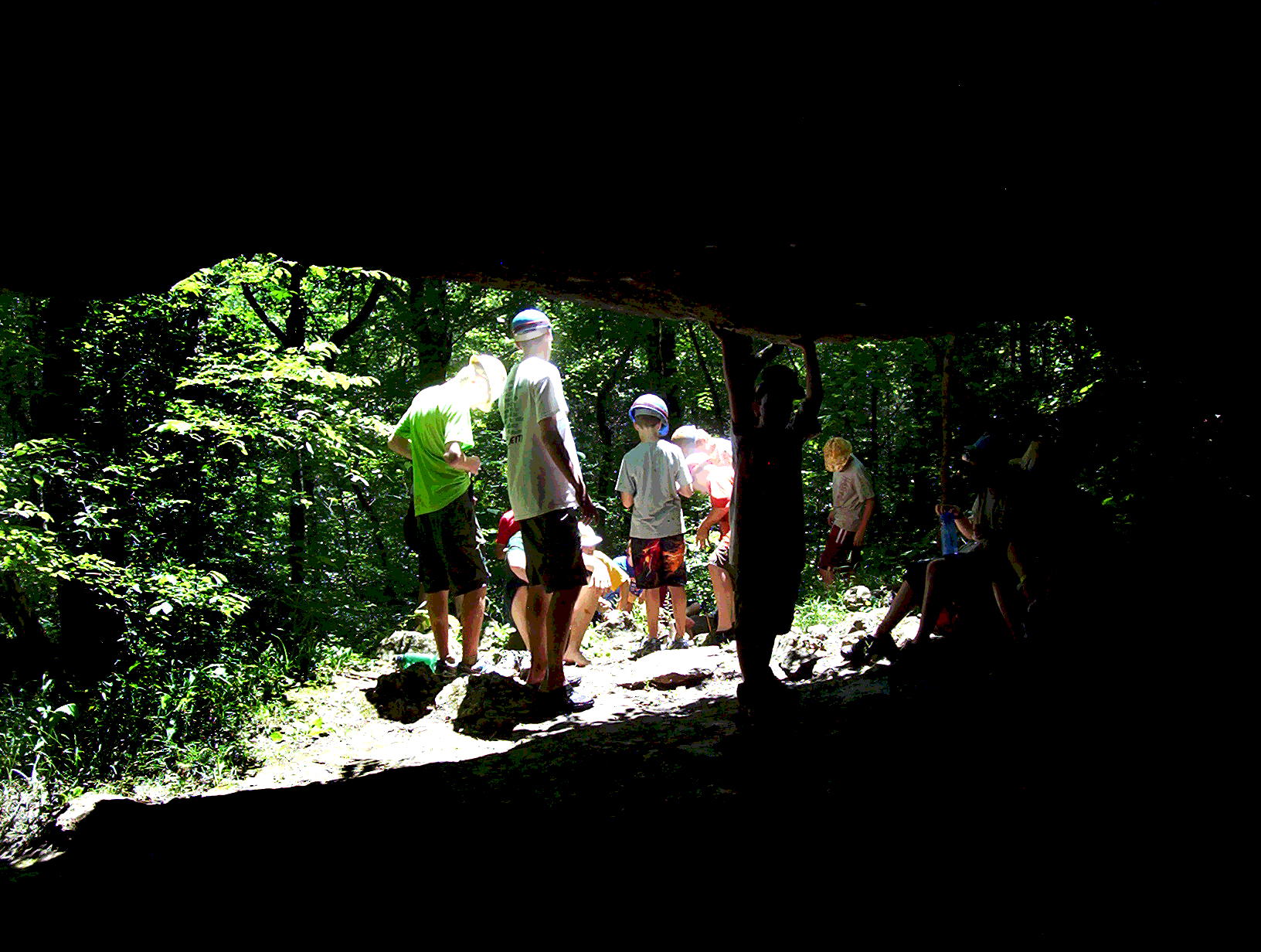
Boys prepare to enter the Mud Cave

The last known picture of the lost boys before they entered the mystical Mud Cave.

By Jeffrey Bishop

Tell Time: 10 minutes 30 seconds
Scare Rating: 3/5 Ghosts

It was the last day of summer camp, and it was hot.  The boys had been especially obedient in packing out the campsite, and even Bear, the grizzled old camp steward, couldn’t find a thing to grouse about on final inspection.

Maybe the boys had become a well-oiled machine after spending all week working and playing together.  Or maybe it was because Trent, their camp guide, had promised them a trip into the camp’s fabled Mud Caves if they did a good job clearing their campsite.  Whatever the reason, the boys had earned the adventure.

“Fill you canteens and make sure you’re wearing sturdy shoes — it’s time to hit the trail!” Trent shouted.

The boys fell in line and Trent led them through the wooded hills on a narrow trail that seemed to be little more than a deer path in most places.  Scotty was on the lookout for signs of life, and would point out to the boys around him owl pellets on the ground, a woodpecker in the canopy or the tracks of a raccoon crossing theirs.  But despite his attempts at educational diversions, all the other boys had just one thing on their minds:  the mud cave.

“How far do you think it is to get there?” asked one.

“Do you really think there is a mud cave, or is this a trick to get us to complete a hike for the hiking achievement?” shouted another in his excitement.

“I hope there aren’t any bats in the cave!”

“I hear there’s a secret at the end of the mud cave!”

“Why do they call it the mud cave, anyway?”

After more than a half hour of walking and wondering, the group finally arrived at the mouth of the cave.  The entrance had a wide, but low foyer, with a trickle of a stream cutting through the soft clay dirt floor.  Trent set them down to cool off.  And the boys finally got answers to some of their questions.

“Obviously, the mud caves have been here for thousands of years,” said Trent.  “But we’ve known about them for only about 50 years.  The old farmer who used to own the land this campsite is on discovered the cave while hunting.  They say that his dogs tracked some game here, but that they wouldn’t go past the mouth of the cave.  Dogs can be pretty superstitious! But some of that jibes with legend; there’s a lot of local lore that talks about strange happenings in the caves in this part of the country.

“This cave hasn’t been fully spelunked — that’s what we call cave exploring — but for the past couple of summers that I’ve been a camp guide here, some of us have explored at least a half mile into the cave. That’s where we found the mud room.  That’s where I’m taking you today.  That’s where you’ll learn first-hand the secret of the mud cave.”

The hook was set; Trent now had the boys’ full attention — which made it easy for him to give an obligatory, if basic, safety briefing.

“Boys, kick off your shoes — you won’t need them, because this spring stream will be a small creek up to your knees for most of the way in,” Trent instructed.  “Number off so we can check attendance along the way — there are 11 of you — and if you can holler to the guy behind you when there’s a step or a drop, I’m sure he’d appreciate it.  Lights on, and let’s go in!”

The boys quickly got into single file and started a new hike deep into the Earth. The water was chilly — if they hadn’t just hiked a mile in to get to the cave, it might have been uncomfortable.  Under their feet, sticky mud gave way to their weight and squished out from between their toes.  The light from the mouth of the cave stayed with them for a ways — not enough so that they didn’t need their head lamps, but just enough to give some comfort against the anxiety of entering the dark unknown.

While most of the boys were simply trying to stay with the group and keep their footing, Scotty, who was at the front of the formation, was on the lookout for signs of life.

“There should be guano and bats!  Lizards or a raccoon’s nest.  Why aren’t we seeing any of that?” he asked Trent.

“We thought the same thing,” replied Trent.  “We even came here at dusk to see if any bats from deeper in the caves would stream out.  They never did.  Unless things have changed, there isn’t any significant forms of life in here.  That might be one of the secrets of the Mud Cave worth exploring.”

Soon, the relatively straight, smooth and wide path changed.  All natural sources of light were gone, and the narrow and sometimes low cave walls seemed to press ominously close.  As they reached out around them — partly for balance and partly to navigate by touch — many of them noticed that the once-hard rock walls were now covered by smooth, sticky mud.  They weren’t solid mud; if you pressed into the mud flesh, it would slide away, revealing the hard bone of the stone walls beneath.

The boys chatted with each other a lot more now, to use their sense of hearing to navigate, and to bring some cheer against the anxiety-raising surprises that the now-ceaseless turns, steps and drops caused.  For a moment, Trent thought that he might want to say something to reassure them, but decided against it; the nerves would heighten the thrill of the surprise that lay ahead.  Besides, they were almost there.

Trudging along, the ever-observant Scotty was the first to notice a change.

“Guys, our voices are echoing, and it’s a lot cooler; I think the cave has opened up!”

Indeed it had.  Trent had stopped ahead of the group, and as the boys trudged behind him, their collective lights filled a large, open room.  A half-dozen large stalagmites  — vertical formations of sediment — emerged from the water at their knees.  Strange to Scotty was the fact that there was no corresponding stalactite from the ceiling above.  He also noticed that they were made from mud; in fact everything that was in the room was mud.

The boys, who were chatty before, were as abuzz as a hive of bees now, clawing mud off the walls to mold in their hands, shouting to hear their voices echo, and clammering with questions for their leader about the room they were in.  This bode well for Trent, who was just as excited to share what he knew with the boys as they were to hear it.

“Boys!” he said, with a snappiness that completely silenced the room save for the single word’s multiple echoes.  With their full attention once again, he continued, but now in a deep, ceremonious voice.

“I’m now able to share with you the secret of the mud cave.  It’s not something that I can tell you about, it’s something that I must show you.  To see it, it must be completely dark in here.  Each of you must turn off your headlamp, and leave it off.”

“But,” started one of the more fearful boys, but Trent was ready.

“Your eyes have become blind by too much sight,” he continued, but quickly realized that his explanations sounded somewhat mystical — and corny.  “Here’s the deal, guys,” he amended, “you don’t have night vision because you’ve been using your headlamps.  If you shut them off, then in a few minutes you’ll get your night vision back enough to see what I want you to see.”

With that explanation, the last couple of lights that remained on were vanquished.

“Now while we wait for our eyes to adjust, I’ll tell you everything that I know about this room,” the leader continued.  “This is the mud room.  I think most of you have figured out why we call it the mud room, and that’s really why this is called the mud cave; it gets less muddy as you get toward the surface, but down here, it’s all mud.

“This is the deepest any of us have ever been, and it might be as deep as we can go.  But we know that it goes deeper still.  And we know that it has secrets to tell.  So remain quiet, hold still and listen for one of them!”

Saying that, Trent stopped talking.  In the silence, the boys could hear things that they hadn’t heard when they were yammering to one another and sloshing along through the cave’s stream.  They heard natural sounds, of water running deep and fast in the caves, of winds streaming through deep earthen valleys all around them like the deep snores of a giant.

“Some say that there’s a hidden waterfall within these caves, hiding treasures or a colony of elves,” Trent continued.  “Some think it’s more pedestrian; that this cave simply links to another cave; indeed, there is a rumor that this cave connects to another one that starts out in the Lady Scouts campsite on the other side of the hill that we’re in.”  That idea got the boys murmuring again; it had been a long week away from television, game systems and girls.  But Trent didn’t lose his grasp on the boys’ imagination for long.

“There are other mythologies about the secrets of this cave,” he quickly added, “but they are too terrible to share with you in here.  While I was not too afraid to come in here, and to bring you here, too, I have a little bit in common with the farmer’s dogs, and I guess I’m a tad superstitious myself.”  This elicited groans from the boys, along with a fair amount of begging to hear the darker secrets of the cave.  Trent had one final card in his hand with which he again was able to maintain control of the situation.

“I am prepared to share with you the one secret of the mud cave that I am certain of,” he said, to a room that quickly settled itself again.  “I can say with certainty that each of you has your eyes closed.  Is this true?”  Not one boy answered, but each nodded.  Trent didn’t bother to confirm their answer.  “I know this because when I’ve been here, I have not been able to keep my eyes open in the dark.  It is too unnerving.  That’s how it was when I was in here the first time and dropped my headlamp into the stream and ruined it; I closed my eyes against the dark.  But at some point while in here, as I searched for the exit, I dared to open them, and when I did … OPEN YOUR EYES!” Trent commanded.

Each boy snapped his eyes open, and was astounded at the vision before him.  No longer were the boys in the mud cave, but they were in the heavens, surrounded by constellations, galaxies, comets and other heavenly orbs.  The “oohs” and “ahhs!” one might have expected were suppressed by the raw sense of awe in each boy.

“These aren’t the heavens,” said Trent of the bluish lights speckling the walls and ceilings of the cave room.  He was again using his deep, monotonous and dramatic voice.  “We think that they must be some sort of phosphorescent life form.  They might come from a mold or a moss.  But they have power.  You can sense their power!”

As the boys continued to look upon the lights, the intensity with which they glowed increased, to the point where the light, incredibly, was blindingly bright, and each boy was frozen in place, staring in wonder at the vision all around them.

~

The search party quickly found the cave entrance; the dogs easily tracked the scent of the group along the trail to where a pile of shoes and socks and a couple of digital cameras and other precious electronics were left behind to avoid the risk of being dropped in the cave’s stream. Strangely, however, those same dogs would not go any farther into the caves than its mouth.

Nevertheless, the detectives on the case, aided by worried camp staff and parents, followed the stream as far into the caves as they could.   They brought into its darkness as much light as possible to try to find the lost boys.  All they discovered at the cave’s terminal point was a large, open room with 18 lonely stalagmites scattered across its wet floor.

THE END
Copyright 2012

What do you think is the true secret of the mud cave?  What do you think the blue lights are?  How are they connected to the lost mythologies that Trent was too afraid to share in the cave?  Was Trent the perpetrator, or another victim, in this story?  How do stories like this “survive” when the people to whom they happen do not?

Lessons for the Workplace Learned From Summer Camp

•July 25, 2012 • 2 Comments

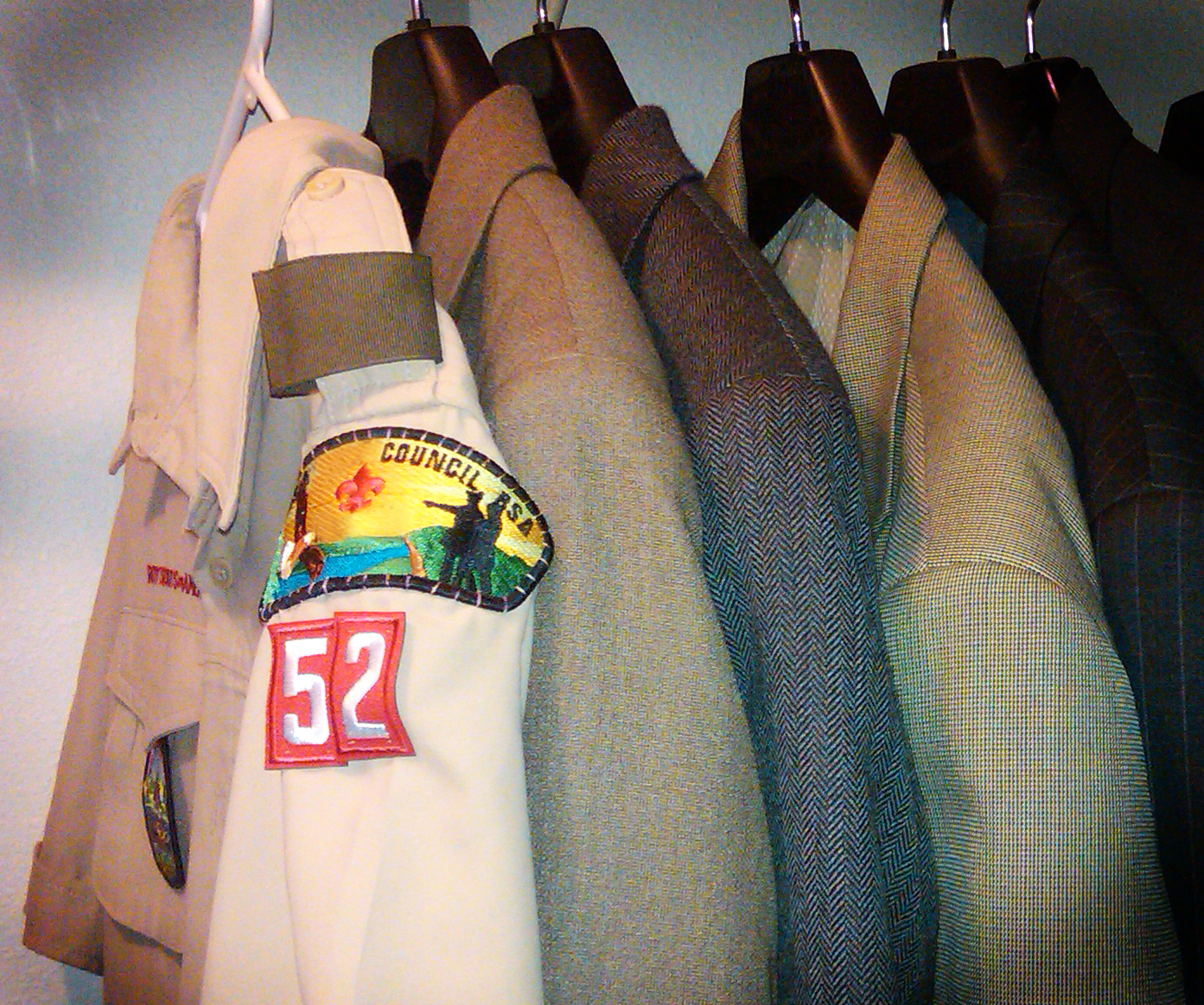
A Boy Scouts Leader shirt hangs in a closet alongside business attire

By Jeffrey Bishop

Each of us has a number of roles – and titles that go with them – beyond the one listed for us in the global address book / outside our offices / in our signature blocks.  One of my alter egos is that of the Scouter, a term which means that I am an active and enthusiastically involved leader to Cub Scouts and to Boy Scouts.

I get to be a Scouter one or two evenings per week and on at least one weekend per month.  Additionally, each year, I’m also a Scouter at summer camp.  During these activities, I feel a keen sense of honor as I invest in the lives of more than 100 boys – really, they are men-in-the-making – including my two sons, 13 and 10.

Reflecting on our most recent camping excursion, I certainly remember the heat of the 108-degree days and the ever-present stink of the bug repellant.  I also recall the lessons that I gleaned from observing our boys growing up a little bit, right before our eyes.  There are three in particular worth sharing, as they are just as applicable in our offices as they are in the woods:

1) Rely on the patrol method.  The patrol method is designed such that the Boy Scout Troop is adult-guided but boy-led.  Each Troop has a Senior Patrol Leader, along with a small number of subordinate Patrol Leaders who have a discrete span of control within the camp.  If adults are running things, then they are working too hard; worse yet, the boys are not able to get from the experience what they need to get from it to develop into tomorrow’s leaders.

Organizations that operate well employ a similar model; in the military, it’s referred to as “centralized command, decentralized execution.”  In an organization like mine, it means that I receive my mission, vision and top-level direction from my senior leadership, but I am empowered at a lower functional (or geographic) leadership level to carry out the mission day-to-day.  Assuming that I and the people that I work with are well trained and qualified in our roles – and in most organizations, we are – then the organization runs extremely efficiently and effectively.  Maximizing the patrol method model at all levels of your organization will enhance performance, morale and staff development.

2) Be Prepared.  Abiding by these two words – the Boy Scouts Motto – is like having a Swiss Army Knife in your pocket.  It’s helpful to anticipate what you might need in advance, and then do what you can to prepare for that – be it via having the necessary information, coordination, resources, tools or training for the task.

A Scout won’t hit set out on a hike without a buddy, a plan, a trail map, appropriate clothing, light nourishments and a first-aid kit.  Don’t enter a business situation – be it a client meeting, a presentation, a conversation with your boss or any other daily work responsibility – without being similarly prepared.

3) Follow your Compass.  By this I don’t mean a literal compass – for the most part, today’s Scouts navigate by GPS anyway.  But rather, ensure your daily practices align with your values.

Every quality organization has a set of waypoints that highlight the values that show its members the way through all situations.  Similarly, any military Veteran that you encounter will surely remember – and will still follow – the credo and values of his or her service (Air Force Core Values:  “Integrity First, Service Before Self and Excellence in All We Do”).

The Scouts have a number of guideposts, including the Boy Scouts Motto, but also the Cub Scouts motto (“Do Your Best,”) and the Boy Scouts Slogan (“Do a Good Turn Daily”).   In addition to those noted above, the Boy Scouts also have twelve points, called the Scout Law, which exist to guide boys through their Scouting careers and beyond:

A Scout is
• Trustworthy
• Loyal
• Helpful
• Friendly
• Courteous
• Kind
• Obedient
• Cheerful
• Thrifty
• Brave
• Clean and
• Reverent

Regardless the source, be they from Scouts, the military, your own organization or from one’s faith – the concept of values – a compass to show the way – is not too deep a concept for young boys to learn and to follow.  And just as they are for young Scouts, they are timeless to provide a waypoint throughout one’s career, be it in Scouting or in the broader world of work.

What other lessons for the workplace can be gleaned from the Scouting experience?  In what way would your organization improve if the principles and values of the Cub Scouts / Boy Scouts were at work, well, at work?

•July 13, 2012 • Leave a Comment

Lots of Internet searches today for Friday the 13th and Friggatriskaidekaphobia (thought we were the only ones who knew this word!) … Good luck on the second Friday the 13th of 2012!

Random Handyman's avatarFear Naught Tales

By Jeffrey Bishop

The fear of Friday the 13th is called friggatriskaidekaphobia

The fear of unnecessarily long words is hippopotomonstrosesquipedaliophobia.

Enjoy what’s left of the day!

THE END

Copyright 2012

View original post